
SAF CONUNDRUM

Airlines have committed to carbon-neutral growth by reducing carbon dioxide (CO2) emissions by 50% in 2050. Reducing carbon growth will require non-fossil-sourced fuels, referred to as sustainable aviation fuel (SAF)

The domestic jet fuel market size (JET A) is about 26 billion gallons per year. The global market size exceeds 81 billion gallons. Passenger demand is projected to double over the next 20 years (IATA 2016).

 Airlines are very price-sensitive because jet fuel accounts for approximately 30-40% of their operating costs.

The cost of SAF production can vary widely depending on the feedstocks and production technologies used.

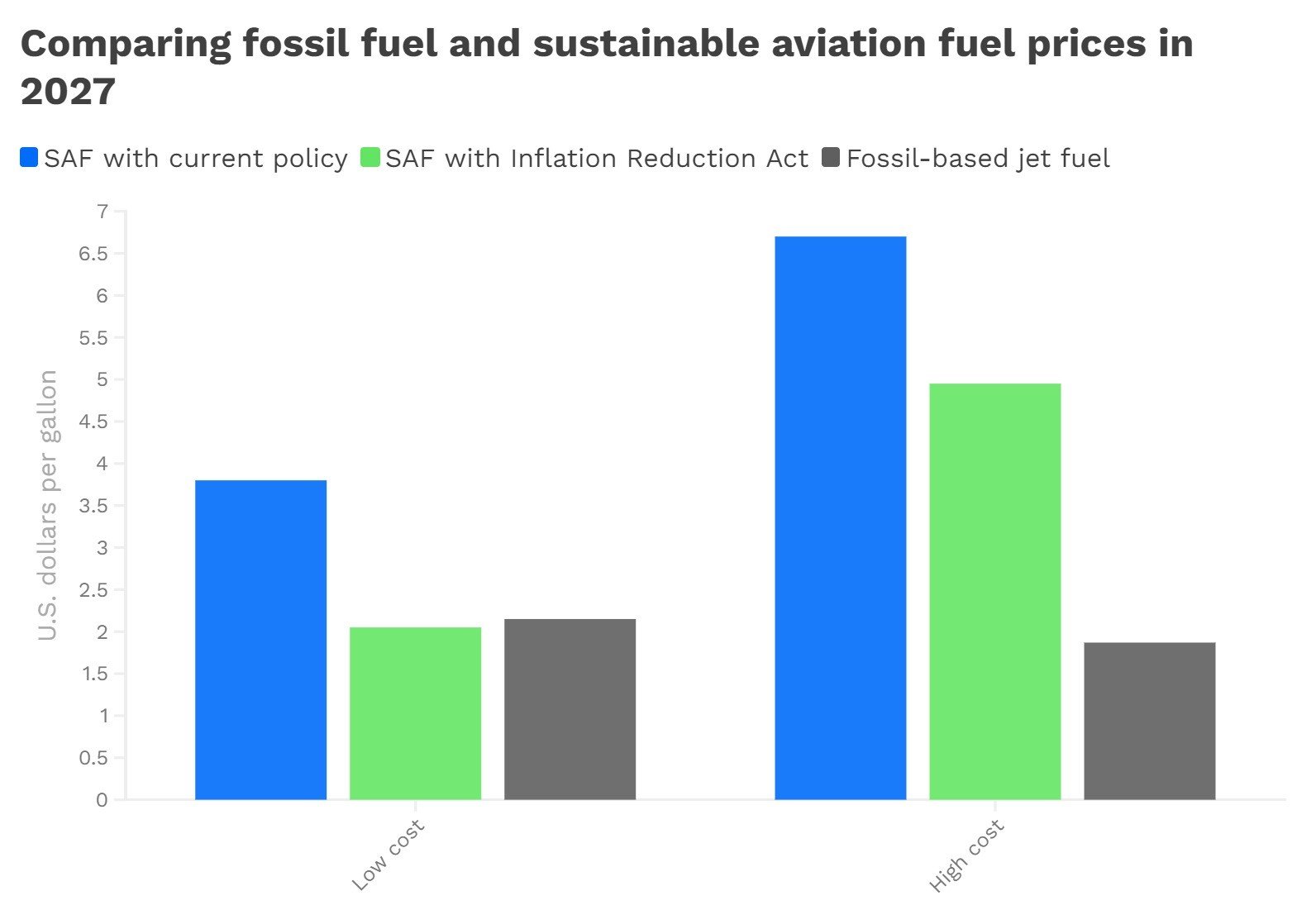
IATA estimates the cost of SAF is between two and four times higher than Jet A, although a recent announcement by Air France-KLM implied that the cost differential may be more like four to eight times the costs of kerosene.

For Air France, the way to square the circle of increased costs for using SAF is to introduce a SAF surcharge. The new fuel levy, voluntary for the moment, will see a charge of between €1 and €12 added to ticket prices depending on the flight length and the cabin class.
SAF production and use reached only 15.8 million gallons in 2022, or about 0.1 % of the fuel used by the airlines.

As of January 2019, six fuels pathways are approved as annexes to ASTM D7566 for the production of SAF:

1. Fischer-Tropsch [FT]-SPK was approved in June 2009 for up to a 50% blend with petroleum-derived jet fuel. FT-SPK is a mixture of iso- and n-alkanes derived from synthesis gas using the FT process. Syngas can be produced from reforming natural gas or from gasifying coal or biomass.

2. HEFA-SPK was approved in July 2011 for up to a 50% blend with petroleum-derived jet fuel. The molecular composition of HEFA-SPK is similar to FT-SPK, consisting of iso- and n-alkanes. The alkanes are the product of hydrotreating esters and fatty acids from fats, oils, and greases and from oilseed crops or algae.

3. SIP, hydro processed fermented sugar-synthetic iso-paraffins was approved in June 2014 for up to a 10% blend with petroleum-derived jet fuel. Unlike SPK from HEFA or FT, this is a single molecule, a 15-carbon hydrotreated sesquiterpene called farnesane, produced from fermentation of sugars. Today, the fermentation is done commercially from sugar cane juice and is used in higher-value applications, most commonly in personal care.

4. Alcohol-to-jet [ATJ]-SPK was approved in April 2016 for SPK from iso-butanol (30% blend with petroleum) and expanded in April 2018 for SPK from ethanol and for fuel blends up to 50% with petroleum. ATJ-SPK consists of iso-alkanes of 8, 12, or 16 carbons when starting from iso-butanol. The iso-alkanes are highly branched and have lower DCNs than FT or HEFA, based on data from Gevo, Inc. Sustainable Aviation Fuel: Review of Technical Pathways 20 The carbon number is broadened, and the branching level can be significantly reduced, leading to a DCN similar to FT and HEFA when starting from ethanol.

5. Applied Research Associates Catalytic Hydro thermolysis Jet, or ARA CHJ was approved in January 2020 as a 50% blend. The fuel is produced from lipids using a supercritical hydrothermal process, creating a blend stock that contains all four hydrocarbon families: n-, iso-, and cyclo-alkanes and aromatics.

6. HC-HEFA synthesized paraffinic kerosene from hydro processed hydrocarbons, esters, and fatty acids was approved in 2020 as a 10% blend. This is specifically for lipids from a B. braunii algae that have been hydrocracking/hydro isomerization to remove all oxygen and saturate double bonds. The product is rich in iso-alkanes. This is the first approval through the fast-track process.

For the purpose of this article, we will concentrate in number 2 and 4 approved pathways which we believe to have currently the most potential to scale up the SAF volume in a commercially viable way.

Benchmark Background:

Benchmark group of companies are well known for successfully developing technology and industrially scaling processes in a commercially effective manner.

Benchmark had the experience of the citrus industry, where new processes and new by-products extractions was necessary to “squeeze” more margins in a highly competitive market.

Benchmark has consistently turned down working on projects and technologies that in our view were not commercially ready.

Pathway Number 2:

Jet fuel properties fall within the light end of the diesel envelope and hence biofuels companies could sell to either market. Diesel fuel (ground transportation) is a significant competitor for lipids, including fats, oils, and greases.

Due to perceived lack of available feedstocks, SAF supporters believe that the lipid routes are not likely to meet the SAF volume demand.

However, the step up from biodiesel to SAF is simple, requiring only further refining and cleaning.

A hydrotreating process could be included to help eliminate impurities, reduce the oxygen and increase the energy content (5-10% more) to match the energy content of petroleum diesel.

We believe the feedstock supply can be augmented by promoting high oil rotational, non-human crops that can provide the lipids required. Sample of these crops include Camelina (mustard seeds), Hemps, Pennycress and others. Even the lipids of algae can be utilized to manufacture SAF.

As an example, 37,750 acres of Camelina (In a rotation program with grain sorghum) can provide enough oil to feed a 10 million gallons of SAF per year plant.

Benchmark owns a patent for removing oil from fibrous material that has proven very effective across different processes and applications. We are confident that by promoting cultivation of rotational crops we can industrially extract the lipids necessary for a biodiesel-SAF plant.

We estimate that SAF cost per gallon utilizing Pathway 2 can be commercially competitive with JET A fuel.

Pathway Number 4 - Alcohol to JET Fuels (ETJ)

We continue to review the potential different technologies available to convert fuel ethanol into SAF.

However, thus far, there are costs that need to be managed to commercially develop an SAF processing plant utilizing fuel ethanol as a feedstock.

Amongst factors of production difficult to control we find:

  • High Energy requirements to produce the Syngas. As an example, there is demand of 90 MW of electricity on a 10 MGY ethanol to SAF plant.

  • High CAPEX on the Syngas Plant in addition to the CAPEX to produce ethanol.

  • Use of renewable green hydrogen anticipated.

  • Expensive rare metals are required for the reformers that will have a limited useful life and will need frequent replacement.

  • Technical challenges in fuel conversion: The conversion of ethanol to jet fuel requires a complex series of chemical reactions that can be challenging to optimize. One potential issue is the formation of unwanted byproducts during the conversion process, which can reduce the overall efficiency of the process, ethanol to SAF yield and increase emissions.

  • Cost competitiveness: The production cost of ethanol-based jet fuel is currently higher than conventional jet fuel. The cost of production remains higher due to the complexity of the fuel conversion process.

Proponents of the ethanol to jet fuel pathway generally include the utilization of “Green Hydrogen” to reduce the carbon score in the production of SAF.

Green hydrogen is produced from the electrolysis of water using renewable electricity, such as solar or wind power, and is considered a promising pathway for decarbonizing the energy sector. However, there are some potential shortcomings associated with the production of green hydrogen:

  • High cost: The production of green hydrogen can be expensive due to the high capital costs associated with building and operating large-scale electrolysis facilities, as well as the cost of renewable electricity. This can make green hydrogen less competitive than conventional hydrogen produced from fossil fuels.

  • Energy requirements: The production of green hydrogen requires a significant amount of renewable energy, which can be challenging to produce in sufficient quantities, especially during periods of low renewable energy generation. This may require the installation of additional renewable energy capacity or energy storage systems to ensure a reliable supply of green hydrogen.

  • Water use: The production of green hydrogen requires a large amount of water, and in some regions, water scarcity may be a constraint on the scalability of green hydrogen production. However, the use of wastewater or seawater for electrolysis can help to mitigate this issue.

  • Production scale: The production of green hydrogen is currently limited by the availability of renewable electricity, as well as the availability of water and electrolysis equipment. Scaling up green hydrogen production to meet the needs of SAF production will require significant investment and infrastructure development.

  • Supply chain challenges: The production and distribution of green hydrogen will require the development of new infrastructure, such as hydrogen storage and transport systems. This can be challenging and costly, especially in regions with limited existing infrastructure.

Benchmark is currently evaluating green hydrogen for the production of renewable fertilizer (Ammonia).

A competitive comparison of SAF vs. JET A utilizing projected revenues between a fuel ethanol plant vs. utilizing the ethanol as a feedstock for JET A / SAF will look as follows:


Note: Platts reported the retail price of SAF during Q4, 2022 in California at $8.28 per gallon. SAF Tax Credit according to new Inflation Reduction Act legislation.

From the above analysis, one can conclude that currently there is not enough of a step up in revenues when utilizing ethanol to SAF, to support commercially competing with JET A.

Overall, the ethanol to jet fuel pathway has the potential to be a promising pathway for the production of SAF, but there are shortcomings that must be addressed in order to ensure that this pathway can be implemented in a sustainable and cost-effective manner.

We continue investigating the different SAF pathways, however we need more testing including developing new production processes (utilization of super-heated steam) to affect a breakthrough in the costs of SAF production.

 For additional information, please contact the company.

Raeford NC Project Sustainable Development Goals UPDATE

The Raeford Advanced Biofuel project (“The Project”) complies with several of the SDG goals as stated by The United Nations.

The Project has received a “Green” designation by Kestrel Verifiers for the issue of corporate bonds to fund the execution of the advanced renewable biofuel construction and start-up.

Kestrel Independent Report confirmed that The Project meets the eligibility criteria of reduced air emissions compared to conventional processing plants. In addition, the use of grain sorghum as feedstock in combination with the biogas for energy, reduces the carbon footprint of the operations, granting the company a lower Carbon Index as compared to conventional ethanol plants.

The direct compliance of The Project with The United Nations Sustainable Development Goals (SDG) as confirmed by Kestrel Verifiers are the following:

SDG 6: Clean Water and Sanitation, which includes targets to ensure availability and sustainable management of water and sanitation for all.

SDG 7: Affordable and Clean Energy, which includes targets to ensure access to affordable, reliable, sustainable, and modern energy for all.

SDG 9: Industry, Innovation, and Infrastructure, which includes targets to upgrade infrastructure and retrofit industries to make them sustainable, with increased resource-use efficiency and greater adoption of clean and environmentally sound technologies and industrial processes.

Benchmark Managements anticipates that once The Project is in operations it will further comply with the following SDG’s:

SDG 8: Decent Work and Economic Growth, which includes targets of promoting economic growth and sustainable employment. In addition, it contains goals to promote youth employment, education, and training.

Raeford’s Hoke County in North Carolina is currently classified as Tier One, ranking among the most economically distressed counties in North Carolina. Hoke County will benefit from the new sustainable jobs created by The Project.

The collaboration with North Carolina State University with the anticipated internship program at the Raeford plant will promote youth employment, advanced biofuels education and training.

SDG 12: Responsible Consumption and Production, which include targets for implementing a 10- year sustainable production plan and encourage the adoption of sustainable production practices.

Benchmark development of local sorghum cultivation includes agricultural supervision of farming practices. The promotion of sustainable farming practices will contribute to reduce GHG emissions in the production lifecycle of the advanced biofuel and comply with SDG 12.

The Project has been calculated to commence operations with a very efficient Carbon Index (“CI”) of 44.7 g CO2e/MJ.

The initial low carbon index is accomplished mainly by utilizing biogas to produce thermal energy, thus eliminating the use of hydrocarbons in the production process.

However, the company anticipates reducing the CI to ZERO or even negative by applying further technology to the lifecycle of the production process.

Among the initiatives to be undertaken upon re-starting operations are the following:

1. CO2 Sequestration:

Benchmark is preparing to start the permitting and test drilling immediately after initiating construction and modifications at Raeford.

Benchmark has experience in developing geological work for CO2 well-injection sequestration and has designed and installed methane CO2 cleaning equipment in the past.

We have confirmed the presence of a saline aquifer in Eastern North Carolina suitable for CO2 injection-permanent sequestration.

2. Local production of Grain Sorghum

Benchmark development of local sorghum cultivation includes agricultural supervision of farming practices. The company will promote and demonstrate No Till planting, new water management practices for sorghum, use of renewable fertilizers (renewable ammonia), use of biodiesel in farming machinery and others. These practices once fully implemented will have a significant impact on the carbon index score of the production lifecycle.

For additional information, please contact The Company

Biogas Digesters for Ethanol Production

Benchmark’s ethanol plants re-engineering includes incorporating an Anaerobic Digester to produce renewable biogas and generate 100% of the thermal energy required for processing the ethanol and the by-products. It eliminates the use of hydrocarbons from the process.

History of Anaerobic Digesters

The first anaerobic digester for biogas production was built in France in 1860; it was converted from a settling basin of a sewage system.

In 1925, a heated anaerobic digester was designed and built in Germany.

The first anaerobic digester in the United States was established in 1926 and the digester was operated with a temperature control system.

Significant effort was spent on aerobic digestion of organic waste materials for biogas production in Europe and the United States after World War II. However, relatively cheap petroleum had prevented anaerobic digestion for biogas production from becoming a major energy generation technology and a main source of thermal energy.

More than 5 million anaerobic digesters were built in China. Most of them small household scale and operated under ambient temperature. However, only a few anaerobic digesters in the United States and Europe were built for generating thermal energy.

In recent years, biogas production has again attracted worldwide attention and wide adoption as a renewable energy source because of sustainability goals and environmental concerns regarding fossil fuels, in addition to becoming cost competitive and enhancing domestic energy security.

More than 17,000 biogas plants were in operation in Europe by the end of 2014. These plants are producing biogas through anaerobic digestion from a variety feedstock material.

The United States currently only has 2,200 operating biogas systems, representing less than 20 percent of the total potential.

Benchmark designed Anaerobic Digester

For a 60 MGY ethanol production, Benchmark will build a 30-million-gallon Anaerobic Digester.

The new Anaerobic Digester is a proven Benchmark Design LLC technology and will operate at moderate controlled temperatures (30 C – 37 C). This temperature range is classified as a Mesophilic Anaerobic Process. These types of digesters are easy to start up, `have very stable performance and are relatively high in microbial activities.

One main feature and competitive advantage of Benchmark’s Digester is the control and uniformity of the proprietary feedstock used to generate the biogas in a mixed flow reactor. (Feedstock System and Process to Producing Biogas from an Ethanol Slurry Mix- Patent # 11,046,925)

Generally organic feedstocks used for biogas production (especially waste organic materials) may contain inhibitory chemical compounds that, at certain concentration, can cause anaerobic digestion upsets. Among the undesirable compounds commonly found in waste materials are ammonia, sulfide, and other metals.

Benchmark formulated feedstock is free of any of these inhibitory compounds, which constitute an additional level of safety for the uniform production of biogas. In addition, the proprietary feedstock to be utilized has been thoroughly tested in a variety of concentrations and optimization of performance and will result in a state-of-the-art Digester, with significant margins of safety in terms of biogas production volume required for full and continuous operation.

For additional information, please contact the company.

Note: Some of the information on biogas digesters was sourced from the book “Biomass to Renewable Energy Processes” authored by Dr. Jay J. Cheng, PhD, professor at NCSU Biological & Agricultural Department.

Benchmark Raeford North Carolina Advanced Biofuels will not be a Destination Plant

There has long been discussions and debate regarding the location of biofuel plants. Most plants have been located near the source of feedstock (corn) in the Midwest as opposed to the end user demand in the east and west coast. Plants located outside the Midwest corn belt have been considered “Destination Plants”.

Benchmark has negotiated with North Carolina State University, The Sorghum Checkoff program, local seed companies and farmers, for the developing and growing of 100,000 new grain sorghum acres in North Carolina.

With the incorporation of sorghum higher yielding seed varieties (multiseed traits) the company anticipates securing over 50% of the feedstock requirements within the Raeford vicinity of North Carolina and South Carolina. Within 2 to 3 years of startup, 100% of the grain sorghum is to be sourced from North Carolina, South Carolina, and Georgia.

The Raeford Plant now exceeds many strategic attributes with its location:

1. Raeford NC is located near the high demand markets for low carbon biofuels in the east coast.

2. The plant will be able to source feedstock locally from current farms situated in North and South Carolina.

3. The plant can deliver its improved by-products (DDGS and Oil) to local high demanded feed market of small stomach livestock (Poultry)

The company has formally executed a Memorandum of Understanding (MOU) outlining the plan for establishing the initial 100,000 acres of grain sorghum in North Carolina.

For additional information, please contact the company


Raeford Grain Bins

Sustainable Aviation Fuel (SAF)

The term SAF is used to describe a family of JET FUELS comprised of a blend of conventional jet fuels with non-conventional, more sustainable blending agents. This SAF blend is what is defined as the fully ready drop-in fuel that can be used to replace conventional jet fuel.

Because SAF is a relatively recently adopted term, some companies working in this field may also use the terms bio-jet, renewable jet, bio-kerosene, alternative jet, non-conventional jet fuel, etc., or specifically by the several names in the conversion pathways outlined in ASTM D7566.

Currently there are proven processing pathways to produce SAF.

1.- The Hydro-processed Esters and Fatty Acids (HEFA-SPK) process, which converts vegetable oils and animal fats into hydrocarbons by deoxygenation and hydro-processing. Blending limit: up to 50%

2.-The Fischer Tropsch (FT) Synthetic Paraffinic Kerosene (FT-SPK) process that converts coal, natural gas, or biomass into liquid hydrocarbons through an initial gasification step, followed by the Fischer-Tropsch synthesis. Blending limit: up to 50%

3.-Synthetic Iso-paraffin from Hydro-processed Fermented Sugar (HFS-SIP), (formerly referred to as Direct-sugar-to-Hydrocarbon [DSHC]), converts sugars to pure paraffin molecules using an advanced fermentation process. Blending limit: up to 10%

4.-The Alcohol to Jet SPK (ATJ-SPK) pathway starts from an alcohol to produce an SPK (through dehydration of the alcohol to an olefinic gas, followed by oligomerization to obtain liquid olefins of a longer chain length, hydrogenation, and fractionation). This pathway is intended to eventually cover any C2-C5 alcohol feedstock; at present, it only covers the use of iso-butanol and ethanol. Blending limit: up to 50%

Benchmark has been following the evolution of the SAF market. In the past, for any of these pathways to economically compete with hydrocarbon-based JET FUEL, the price of oil needed to be above $ 90 per barrel; however, with the incorporation of incentives such as Low Carbon Fuel Standards credits, Carbon Offsets, CO2 Sequestration and others, the economics are changing rapidly in favor of SAF.

It’s important to point out that the technologies are proven, and production is a function of competitive price per SAF gallon.

Germany invented and utilized several of these pathways to produce aviation fuel during WW 2 out of desperation and lack of access to oil.

Indirect Fischer–Tropsch ("FT") technologies were brought to the US after World War 2, and a 7,000 barrels per day plant was designed by HRI, and built in Brownsville, Texas. The plant represented the first commercial use of high-temperature Fischer–Tropsch conversion. It operated from 1950 to 1955, when it was shut down when the price of oil dropped due to enhanced production and huge discoveries in the Middle East.

The company believes that the most competitive pathway to develop SAF is to hydro-process Esters and Fatty Acids. We can further improve the production process by introducing cost effective renewable thermal energy and improved management of superheated steam.

The challenge becomes the sourcing of the vegetable oils as feedstock to manufacture SAF.

Benchmark owns a patent for removing oil from fibrous material. We envision capturing and processing rotational and cover crops such a camelina, pennycress, hemp, and others that have high oil content, maximized with the improved Benchmark oil extraction processes.

As a result, the new cost per gallon of SAF using vegetable oils can be very competitive.

For additional information, please contact the company.

Sustainable _Aviation_Fuels_Airport_160329_149_16-9.jpg

CO2 Sequestration at Raeford North Carolina

Benchmark intends to undertake the development work for a CO2 injection project at the Raeford North Carolina plant including evaluation of the saline aquifer suitability, injection well permitting requirements, incremental air emissions, and DOE co-funding investigation.

Benchmark participated in the pre-development of an ethanol project in Aurora North Carolina (approximately 180 miles from Raeford) where CO2 sequestration was determined feasible to be injected unto the underground saline aquifer. We anticipate the geological conditions in Raeford (Coastal Plain) to be comparable to the conditions in Aurora. The important nature of the CO2 injection project would make it a suitable candidate for implementation in a second phase, after the initial commissioning of the Raeford ethanol production operations.

Preliminary Assessment of North Carolina Saline Aquifer Suitability:

Analysis and site characterization were performed in 2006 during the development of the Agri Ethanol Project in North Carolina to determine the feasibility of injecting CO2 in the saline aquifer for long term storage, based on available geological data.

Some of the work performed included:

• Seismic surveys to define the subsurface geological structure and identify features that

could create leakage pathways in the subsurface.

• Formation pressure measurements, if available, to map the rate and direction of

groundwater flow.

• Water quality samples to demonstrate the isolation between deep and shallow

groundwater.

• Geological site description data from wellbores and outcrops to characterize the storage

formation and seal properties.

The project results were obtained in coordination with:

• United States Department of Energy (USDOE) Carbon Sequestration Regional Partnership Programs, in particular the Southeast Carbon Sequestration Partnership, which includes North Carolina (SECARB)

• United States Geological Survey (USGS)

• North Carolina Geological Survey

The analysis identified two potential subsurface zones that have good potential for CO2 sequestration.

These sites are throughout the Coastal Plain in North Carolina at depths greater than 1,500 feet, that contain saline groundwater and are far below the base of the underground sources of drinking water (USDW). These units contain sand zones with thickness of at least 20 feet and the sand zones are underlain and overlain by clay zones with thickness of at least 20 feet. These provide permanent containment and trapping the injected CO2.

If underground drilling proves difficult at the Raeford property, the study did identify an injection site in Sanford North Carolina (50 miles away). This location has sediment-filled Triassic-age rift basins which make it suitable for CO2 Geo sequestration.

Raeford may require a deeper (more costly) drilling to reach the saline aquifer. However, geological CO2 storage is generally considered to be more effective at depths greater than 2,500 feet, where ambient pressures and temperatures can result in CO2 being in a supercritical fluid state. The density of CO2 fluid will range from 50 to 80 percent of density of the saline groundwater under these conditions.

Conclusions:

Based on the Aurora project analysis and review of the geological characteristics in North Carolina, there is the potential in Raeford for permanent containment of CO2 with sufficient storage capacity in sand zones with sufficient thickness, porosity, lateral extent and hydrologically isolated from fresh waters aquifers.

For additional information, please contact the Company

Geological map w Raeford.png

Benchmark Technology

Benchmark group of companies continues developing and advancing technology in the agro-industrial space, delivering engineering solutions to improve yields, operational margins and transforming the use of conventional energy.

We are pleased to inform that the U.S Patent and Trademark Office has approved the Patent Application No. 16/682,457 consisting of a System and Process for producing Biogas from an Ethanol Slurry Mix.

We consider this patent fundamental for deploying the use of renewable energy, further reducing the Carbon Index in the ethanol and advanced biofuel industry.

This technology allows the self-generation of biogas for the required energy in the production bio-conversion process, eliminating the use of hydrocarbons.

For additional comments, please contact the company.


Typical Plastic Fusion ® covered Anaerobic Digestor.

Typical Plastic Fusion ® covered Anaerobic Digestor.

Renewable Jet Fuel Outlook

What is the quantity of renewable aviation fuel, as a percentage of pre-COVID-19 worldwide fleet consumption, that could be created per year without adversely affecting food production or causing a negative environmental impact such as deforestation?

Recently, Aviation Week France Bureau Chief, Thierry Dubois had the following comments:

The International Civil Aviation Organization estimates that about 600 million metric tons of jet fuel will be necessary to cover all aviation needs in 2050. This could require up to 45 exa-joules (EJ, a unit of energy) of biomass input to biofuel production, given the relatively low efficiency of the transformation process.

A sustainable biomass supply of 70 EJ could be produced each year, “possibly going up to 100 EJ, thanks to tightly regulated reforestation efforts,” the Energy Transitions Commission (ETC) suggested in a November 2018 report. So all aviation demand in 2050 could be met by sustainable biofuel production, according to the ETC, which is a lobbying group representing energy producers (such as Shell), energy users (such as materials manufacturer Saint-Gobain) and economists (such as Nicholas Stern).

Aviation is a priority, according to the ETC. Fossil liquid fuels—and their biofuel equivalents—are particularly well-suited to aviation because of their energy density. “Aviation is almost the only sector of the economy where there appears to be no feasible alternative to a bio-based route to achieve net-zero carbon emissions,” the ETC report says. Batteries and hydrogen are ill-suited because of their low energy density.

“The Aviation industry cannot rely on developments in the road transport sector to drive biofuel development and production volume—the onus is on aviation to create and foster a viable industry”

A key factor to sustainability is keeping the use of purpose-grown plants to a minimum, as they would compete with food production. In the near future, Fuel should be produced primarily from waste streams. The challenge then is to collect municipal, agricultural or forestry waste.

“There are exciting long-term opportunities with synthetic fuels such as ‘power to liquid,’” adds a spokesman for the Air Transport Action Group (ATAG), a lobbying group in commercial aviation. The process uses sunlight as the power source to convert CO2 from the air and water into jet fuel. Challenges are the low power density of sunlight and the stability—as opposed to reactivity—of water and CO2.

ATAG sees sustainable aviation fuel as part of the solution, along with aircraft technology and operational improvements, for the industry to meet its goal of halving CO2 emissions by 2050 from 2005 levels.

For additional information, please contact the company.

biofuel airline.png

Renewable Energy World Outlook


The renewable-energy industry could create more than a million jobs a year if countries invest enough to meet their target for cutting global carbon emissions, according to an advocacy organization. Solar, wind and other forms of green energy could add 42 million jobs by 2050 if nations spend more aggressively to limit the increase in average global temperatures, the International Renewable Energy Agency said.

Governments should not relax their efforts even though air pollution has abated in places as a result of the coronavirus’s impact on economic activity, the Abu Dhabi-based agency said in a report released on Monday. “This year will be very special because emissions will be decreasing,” Irena Director-General Francesco La Camera told reporters in a conference call.

“But we have to be very careful about a rebound effect that can bring us on the wrong path. What we are calling for is to avoid the wrong policies that may compromise this vision of the future.” Under the 2015 Paris climate accord, governments aim to limit the increase in temperatures this century to less than 2 degrees Celsius (3.6 degrees Fahrenheit). The use of fossil fuels is widely blamed for contributing to global warming, and Irena promotes renewables as a way to minimize climate change. Oil futures fell on Monday April 19 to the lowest in more than two decades, on concern the world is rapidly running out of places to store crude after output cuts proved insufficient to cope with plunging demand. Volatility in oil prices will probably discourage investors.

In its first-ever Global Renewables Outlook, Irena also said: To meet the Paris accord temperature target, global investment in all types of energy must increase to $110 trillion over 2016-2050 from a currently planned $95 trillion The increase would include a doubling in investment in renewables, to $27 trillion from $13 trillion.

This greater renewables investment could create 42 million jobs, up from an estimated 11 million in the industry currently “New jobs in transition-related technologies and sectors are expected to outweigh job losses in fossil fuels and nuclear energy” The world could reach zero carbon emissions if investments ramped up to $130 trillion, of which $38 trillion would need to go to renewables.

For additional information, please contact the company.

green fuels.jpg

Standing By

Shelter in place restrictions are in place across the United States in an attempt to slow and control the spread of the COVID – 19 or Corona Virus. As of this writing there are 122,653 COVID-19 total cases in the US with a reported 2,112 deaths.

The social distancing restrictions have been extended thru April 30, with no certainty if they may have to be further extended. This has resulted in an unprecedented economic contraction in the country.

One implication of the virus-related restrictions is that people are driving much less than before, which means that gasoline and ethanol use are declining. The prices have been further affected by the recent market price reduction in oil prices promoted by a market control and market share battle between Saudi Arabia and Russia.

The price of ethanol has declined $0.36 per gallon or 26% since February, however, as a result of the shelter in place restrictions, the demand of gasoline and ethanol is also been reduced dramatically.

On March 26, The Department of Agricultural and Consumer Economics of the University of Illinois at Urbana-Champaign published a study that attempted to calculate the potential level of ethanol demand destruction over the next few months and the associated impact on corn ethanol use.

The estimated reductions in ethanol use are 143 million gallons in March, 391 million gallons in April, and 207 million gallons in May, for a total reduction of 741 million gallons. Converting these to reductions to corn used to produce ethanol results in a total reduction in corn ethanol use for the three months of 256 million bushels, an amount that would materially increase corn ending stocks for the 2019/20 marketing year.

There is still great uncertainty about the path of the coronavirus pandemic and the severity and length of restrictions necessary to contain the spread.

Looking forward, ethanol still holds the competitive advantage of value as an octane booster. Of all the options available to refiners, ethanol unquestionably has the highest blending octane number and is available at the lowest cost. While ethanol has been used for decades to boost octane, moving forward, the DOE must support the implementation of higher blends and octanes to enable greater fuel economy and significantly reduce emissions.

Numerous studies have shown that the use of high-octane fuels—in the range of 98 to 100 RON—in high- compression engines can greatly improve fuel efficiency and reduce both criteria pollutants and greenhouse gas (GHG) emissions.

The ethanol demand will return once the health crisis subsides. The US Ethanol industry produced 15.8 Billion Gallons of fuel grade ethanol which accounted for 54% of the world’s production of ethanol, with 350,000 direct and indirect jobs supported in 2019.

The US farmers, while enduring the hardship of the Corona Virus situation, are preparing to get back to work, continuing their support for renewable fuels in 2020.

Last week, Reuters polled 26 analysts for U.S. corn and soybean planting intentions. On average they expect 94.328 million and 84.865 million acres, respectively. That would be a 5.2% rise for corn and an 11.5% rise for soybeans.

The combined corn and soybean acres, are estimated at 179.2 million acres. That would be the second-highest in history behind 180.3 million in 2017.

The industry and the markets will respond, stronger than before. We are standing by ready to answer as soon as the health authorities consider it safe.

For additional information please contact the company.

corn+planting+2.jpg